
Going along with last week’s topic, I wanted to show you 5 books that I find extremely disturbing
There are as many books as grains of sand on the beach. More and more are published every day. Books vary in genre, length, and format.
They are a powerful tool that can be used to disseminate information. I don’t want to boycott anything, only to show and invite you to see all kinds of books with curiosity. To think critically about what we read and consume in general.

Some of these books are more modern than others. Each book is a sample of individual expressions. Many times this expression is truly nefarious or evil, other times, beautiful and pure. As human beings are.
Here they go!
1. Life Science and Biology Textbook for Secondary Schools – Erich Meyer and Karl Zimmermann (1492)
Before the rise of the Nazis, schools taught science and biology with ordinary school books, describing fauna, flora, the human body, and the functions of nature.
But in 1942, these textbooks were replaced by the new title “Science and Biology, Textbooks for Secondary Schools”. Written by Nazis Erich Meyer and Karl Zimmermann, these books explained the “Racial Theory” of Aryans, Jews, and other races in the Nazi world.
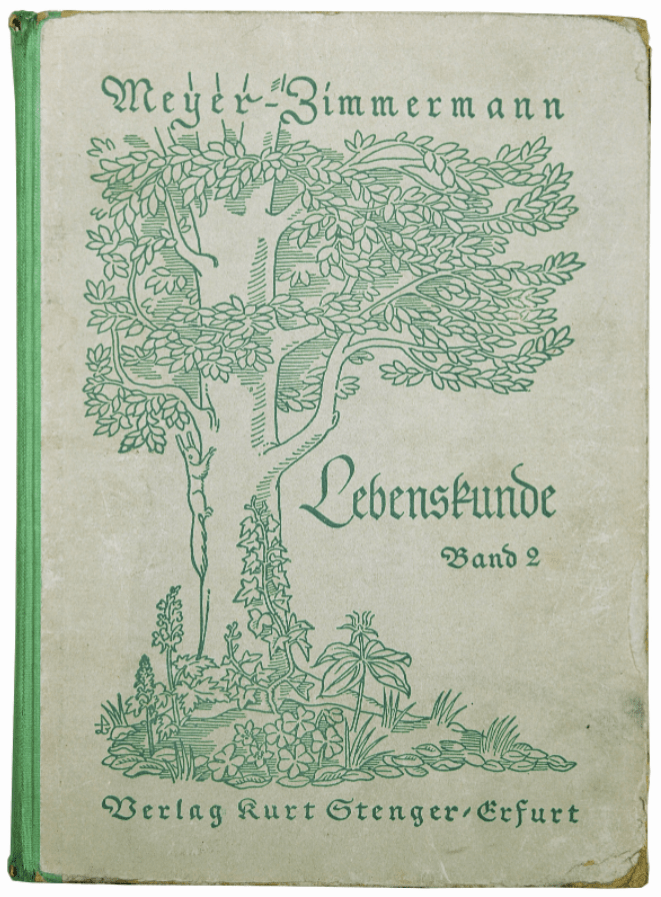
The German blood and German honor was the great argument of the Nazis. And how the Aryan race was the most superior of all. The book explained to children, or rather, brainwashed and indoctrinated them, about how the Germanic race was “soiled” by being mixed with other races, especially the Jews.
To the right, you can appreciate the description —quite serious and factual— of how the mixing of Germans and Jews could give a “mixed race” in varying degrees.
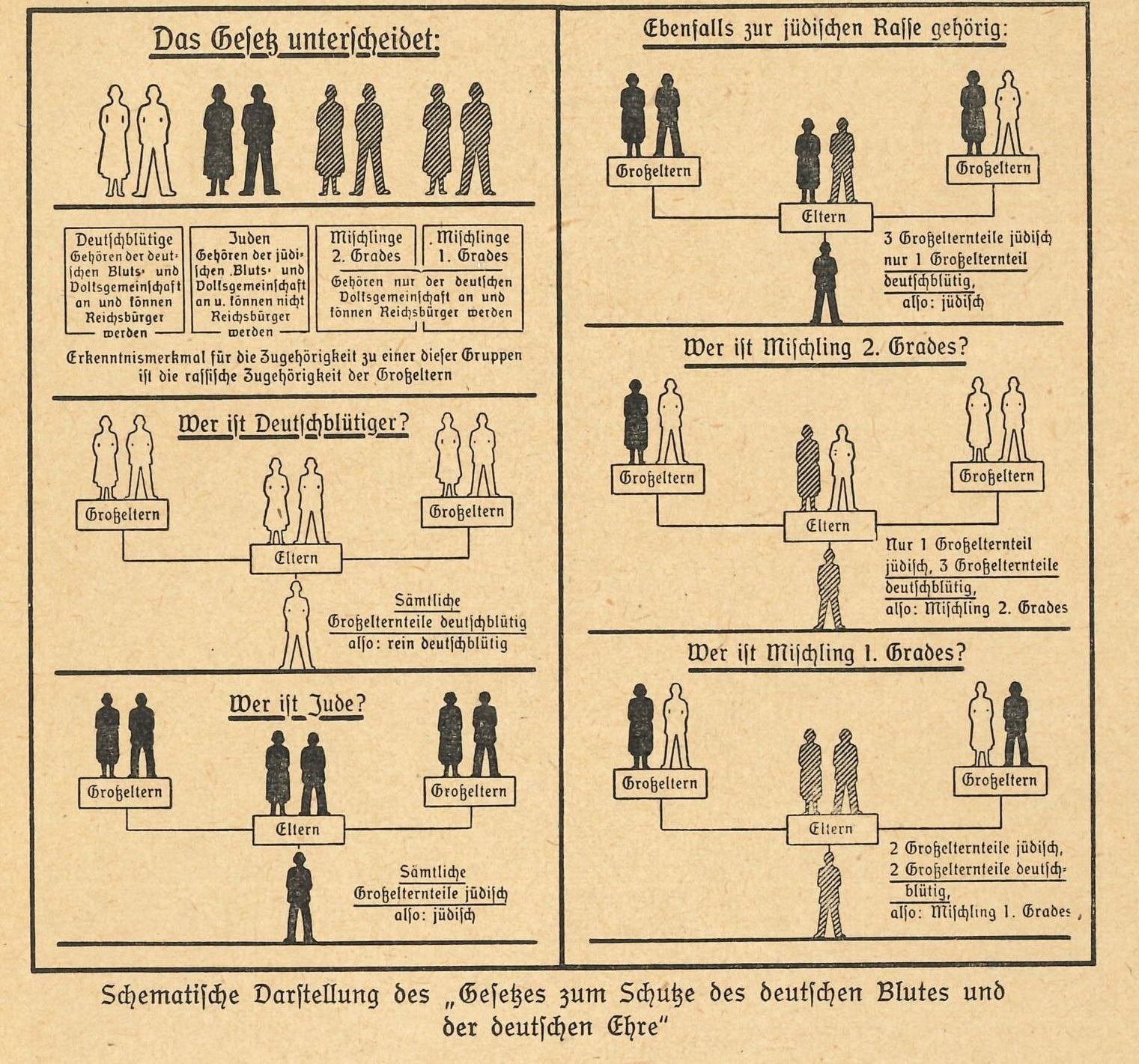
The page on the left shows how the mix between Germans and Jews could give a “mongrel” (sorry for the pejorative word) in different grades, first and second, according to the grandparents and if they were Germans or Jews. On the page to the left, which marriages were allowed and which race would be the “result of it”.
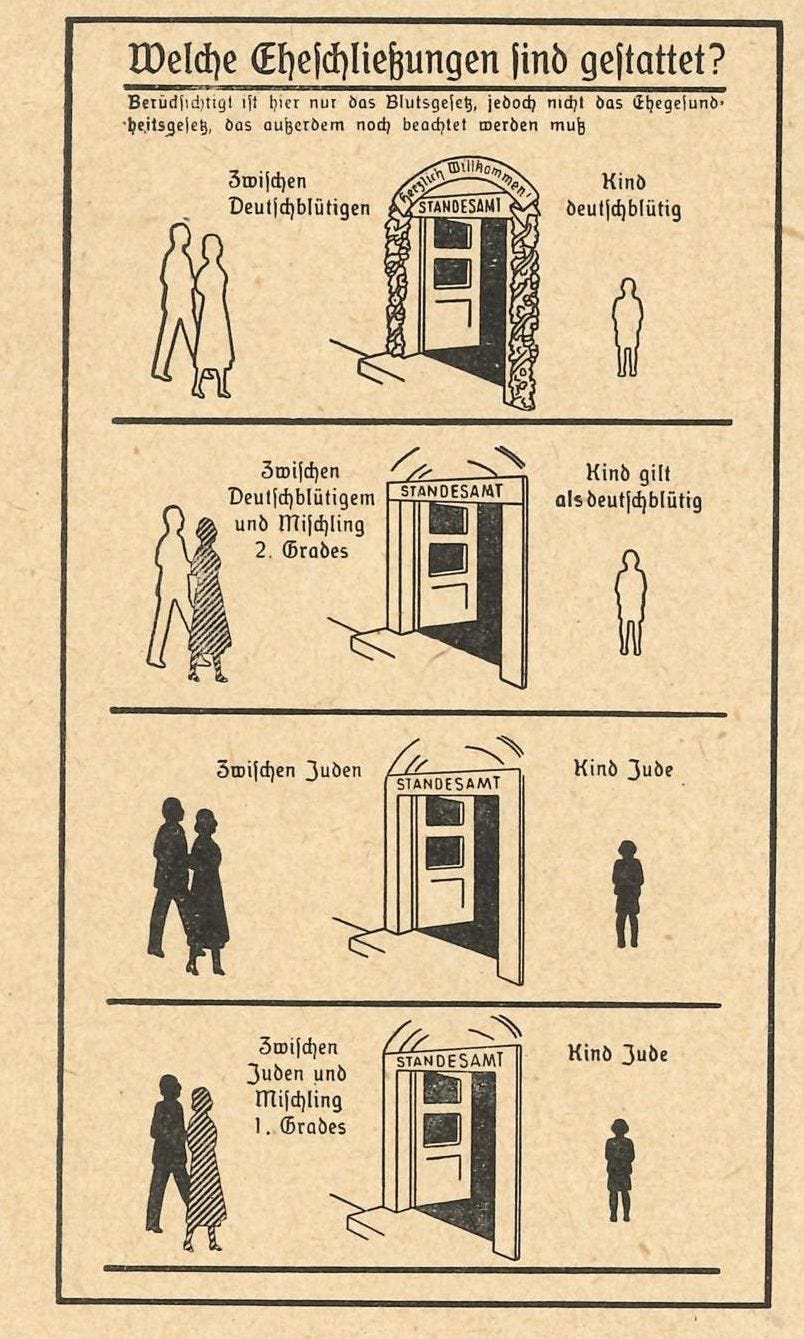
These books really make my blood run hot. Just to think what damaged and twisted messages were instilled in the heads of children. Seriously, who the hell would have the time and energy to check all the family ancestry of people and according to this, choose who lives and who does not? Words are short to depict how nonsense this was.
There are no words to describe the absurdity of the matter.
2. The Book of the Law or Liber AL vel Legis – Aleister Crowley (1909)
Aleister Crowley was an esoteric occultist and founder of the religious-philosophical movement Thelema. He wrote many books on magic, magic rituals, and occultism.
Aleister considered that the history of mankind was divided into Aeons and the Aeon of Horus is the Aeon in which mankind finds itself. Horus is one of the Egyptian deities and was considered the god of the sky, the sun, and protection. Crowley considered himself a prophet of Horus and the Book of the Law were messages from Horus himself, that Aleister got after he summoned him through a Horus´messenger named Aiwass. The book was written in Cairo for 3 days only.

Many of these messages are hidden between the lines. With the help of the esoteric discipline of Kabbalah, which tries to decipher the riddles of the Torah, Aleister tried to decipher them.
The most important messages of the book are:
To do thy will, shall be the whole of the law.
Love is the law, love under will.
Which is a very beautiful message when you superficially look at it. Nevertheless, the work of Aleister is very complex and polemic. The book has a provenance that makes your skin crawl at the thought of it but I believe, it is worth reading and maybe finding meaning in these hidden messages, or not.
3. Malleus Maleficarum – Heinrich Krammer and Jacob Sprenger (1487)
This book became as famous as the bible. It was published in Strasbourg in 1487 and had dozens of versions after its first appearance. Written by inquisitors Heinrich Kramer (France) and Jacob Sprenger (Switzerland). It was a pocketbook manual for Europeans in the Inquisition years, which they carried everywhere.
Malleus Maleficarum crosses the boundaries between fantasy tales, religion, politics, and law. It is a book about witch-hunting, written by Catholics. The book affirmed the existence of witches with all the certainty and seriousness of the matter.
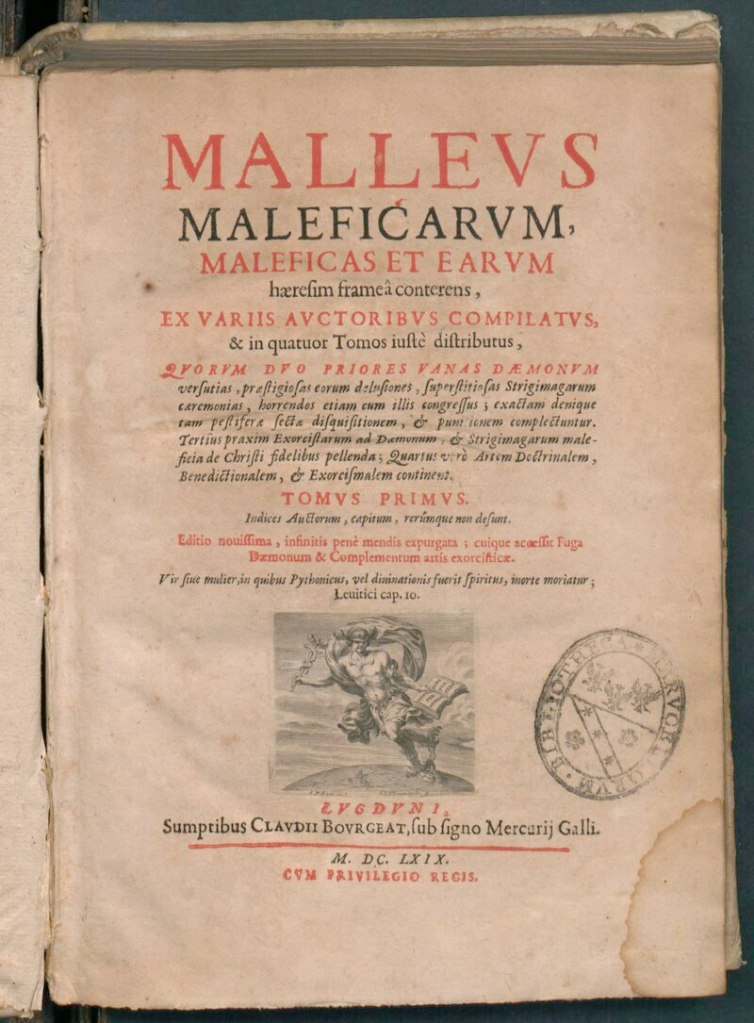
It is divided into 3 parts.
In the first part, assures the reality of witches. Demons and the Devil took possession of bodies that became witches or warlocks. According to the authors, women were the weaker sex and easier to trick, resulting in more witches than warlocks (obviously).
The second part is about which spells these evil women used and how to counteract them with prayers. However, the inquisitors, i.e. the witch hunters, were protected by the power of God, so the spells basically could not cause them any harm.
The third part of the book clarifies how to recognize witches and how to sentence, torture, or destroy them. There was a lot of “evidence” for this, such as women causing erectile dysfunction in men. Or when women were showing themselves as deceitful, ambitious, or erotic, they were clearly possessed by a demon, turning into witches. If there was not enough evidence to prove it, it did not matter, a slight rumor among the villagers was enough to confirm whether or not one was a witch (or warlock, very few times).
If anyone dared to defend any of these witches, that person was being cast under a spell, unable to see the reality of the matter, that person was labeled as “bewitched”.
Today, this book may be fantasy, even satire or humor. But it caused a lot of harm and pain to women (and men, sometimes). It was not until 300 years later that these practices were abandoned and this “information” was pointed out as false. But hey, better someday than never.
This book is another great example of misinformation and what it can cause. Speech, whether oral or written, is a powerful weapon (see book 1.) Usually in history, when someone dares to challenge the forces of power —be it the state, religion, huge evil corporations, or others— it is considered “The origin of evil”. Because of this “risk” humanity faces, extreme security measures must be taken, bypassing human rights, instilling fear and further dividing society.
4. The Story of the Little Mole Who Knew It Was None of His Business – Werner Holzwarth and Wolf Erlbruch (1989)
I had to put this book on the list! This book premise is as wonderful as disturbing.
Written by Werner Holzwarth and illustrated by Wolf Erlbruch, it is about a little mole, who has had someone poop on his head. Guided by his thirst for revenge, the mole tirelessly searches for the culprit. In the search for him, the mole interrogates several animals but they show him – literally – that his poop looks very different from the one the mole carries on his head.
How does someone come up with an idea like that? Don’t know! But I love this book for its simplicity in narrative and dialogues, which are repeated throughout the story. It’s a great example of how a book idea doesn’t have to be flashy and complex. It just needs to make sense to you!
In the end, the mole discovers who the culprit was thanks to the flies who are the experts on the subject of poop. The butcher’s dog, Hans-Heinerich.

5. Codex Seraphinianus – Luigi Serafini (End of 1970´s)
This funny, but in some pages also creepy book is a bit more modern, written by the Italian Luigi Serafini in the 1970s.

The book is an encyclopedia. But it is a very special encyclopedia because it is written in an imaginary language and shows only imaginary things. The 360 pages are divided into chapters:
Flora
Fauna
Bipedal creatures
Physics and Chemistry
Machines and vehicles
Humanities
History
The Codex’s writing system
Food, clothing, manners
Board and card games. Sports
Architecture
Luigi Serafini confirms that indeed, the book makes no sense at all. According to him, it was written without any conscience, but with the intention of evoking the sensation that children have when reading a book they cannot yet understand.
And he succeeds. It is an incomprehensible, entropic book. It looks like a factual book, but it is nothing more than surrealist. It is a beautiful example that a book does not have to have a beginning, middle, and end. A book can consist of what resides in the subconscious, based on sensations and spontaneity.


I end with this book because it is one of my favorites. It is a true satire on the information age, where any nonsense can be considered true. Whether it is that matcha is better than freeze-dried coffee, that swimming is better than walking, that egg white is better than egg yolk, that shouting 3 times like a cricket in the morning promotes creativity, whatever we consider real as a collective, becomes reality.
My Week on Senses
👂 Feeling groovy with this playlist by Brazilian DJ Isaac Varzim. Love the album cover with all the outer space characters!
👀 Reading “Canosa and the Sun” by my friend author and illustrator Jim Pluk!
👅 My sister’s lasagna. Made with potato instead of lasagna dough. I promise to write down the recipe and post it because it was the best lasagna I have ever eaten in my whole life.
👐 I found a gigantic toad! And I had to pick it up so it wouldn’t be killed. When I picked it up I felt its cold, soft, jelly-like skin. Truly beautiful.
👃 The smell of the night invaded with that of burnt wood of a campfire.

Again, thank you so so much for reading and your support.
Coming Up Next
- Because we all love them, we keep on topic books: Materials!
🌟Recommend and subscribe to the newsletter! 🌟 I write weekly about art, creativity, and processes.


 Tina Ovalle
Leave a reply to Klausbernd Cancel reply