
And why we should read them
Today, Forbidden books and some news on my illustrated book “Mija and Toque”
You’ve probably seen it now and then in the news. Thousands of books are being banned in many parts of the world like the United States, Asia, and the Middle East.
Sadly, book bans and burnings have been normal since the book´s invention. This has been seen all over the world, the most famous book burnings have been in America, China, and Germany. But why ban books? Surely this has to do with the power of a book. They don’t want books to give you ideas! And if we think about it, a book can change your way of thinking, just by reading it once, it can start a revolution.

The reality is that what we consume is not under our control, publishers, bookstores, libraries, schools, governments, and churches, choose which titles receive more visibility or which ones go off display. Unless we make an effort to search and investigate, control will be out of our hands.
The argument for banning these books is that many of them deal with violence and sexuality explicitly, as well as racism, abuse, and political criticism. The lists are long and many of these books are simple investigations, autobiographies, or deal with critical social and historical themes, and having ordinary people read these books is not very convenient for many.
One of the banned books is “The Story of Ruby Bridges”, the first black girl who in 1960 managed to study in a white school (while being protected and accompanied by police). The moms behind “Moms for Liberty” argue that the story is divisive and racially charged, focusing 100% on the negatives and how the white people were racist (but weren’t they?).
When I read the story I was probably 13. I felt sad and cried because I didn’t understand how Ruby had to have gone through that because of her skin color. To me, she was the bravest. What the book taught me was not to hate white people, but to be brave, accept myself, and respect every person with every color of skin or race: whites, blacks, blues, greens, yellows, whatever! I didn’t see white people as the bad guys, but I did understand that in this society there are privileges based on the country where you are born or the color of your skin. And for me to have cried was okay. We do not have to try to cover the sun with one hand, “protecting ourselves” by hiding the harsh realities of society and history.
Many teenagers are not ready for many books, that´s true. But sooner or later they will come to them and it is better to accompany the reading of those books, to have difficult conversations instead of looking for the easy way out of banning them. Plus there is a thing called the internet, Duh! Any book is within reach of a couple of clicks.

Here is a list of books banned in various countries, currently or throughout history.
USA
Illustrated Books that range from Nazi history, what it is like to live under a Muslim regime to humor books like Captain Underpants, accused of being sexist.
- Maus, Art Spiegelman
- Where the wild things are, Maurice Sendak (seriously?)
- Fun Home by Alison Bechdel
- Where the Sidewalk Ends: Poems and Drawings, Shel Silverstein
- Persepolis, Marjane Satrapi
- Palestine, Joe Sacco, Edward W. Said
- Street Cop by Robert Coover and Art Spiegelman
- More than 10 books of Captain Underpants
- Metro, a story of Cairo, Magdy El Shafee
Non-Illustrated Books
- 1984, George Orwell (obviously)
- Animal Farm, George Orwell (also obviously)
- To Kill a Mockingbird, Harper Lee
- The Handmaid’s Tale, Margaret Atwood
- Anne Frank: The Diary of a Young Girl, Anne Frank
- The Autobiography of Malcolm X
- Harry Potter and the Sorcerer’s Stone, J.K Rowling
- Lord of the Rings, J.R.R Tolkien
- Hunger Games, Suzanne Collins
- The Catcher in the Rye, J. D. Salinger
- Huckleberry Finn, Mark Twain
- The Great Gatsby, F. Scott Fitzgerald
And the list goes on. It´s incredible how books like these are banned.
I´ve learned so much from them, from the most “serious” ones to the fantasy books. The Great Gatsby taught me a lot about vanity and the ephemerality of the body, beauty, and money. Huckleberry Finn taught me to question the status quo of society and to follow my instincts and heart, even if they go against everyone else. I don’t even want to begin to say everything that Lord of the Rings, Harry Potter, and Hunger Games taught me or Orwell in his works about control through intimidation, fear, and the illusions and dangers of consumerism.
In some Middle Eastern or Asian countries, carrying or distributing some of these books is considered a serious crime. The argument for banning these books is that they do not comply with “Law and Safety.”
China
These banned books deal with political issues and promote democracy. Many of these authors were convicted for daring to go against the government, divulging information that was uncomfortable for those in power.
- I Am Not a Kid, Joshua Wong
- I Am Not a Hero, Joshua Wong
- My Journeys for Food and Justice, Tanya Chan
- On the Hong Kong City-State, Chin Wan
- Hong Kong, the Light Soy Sauce, Zunzi
- The Future of Constitutionalism in Hong Kong, Benny Tai
- Beneath the Keystone – 18 Years in Politics, Margaret Ng
- The Politics of Emotion, Hui Po-Keung
- The Secret Journal of Zhao Ziyang, Zhao Ziyang
Middle East
- Goat Days, Benyamin & Joseph Koyippally
- Liberating Women, written by Judge Qasim Amin
- The Satanic Verses, Salman Rushdie
- The Gods Laugh on Mondays, Reza Khoshnazar
- A Feast for the Seaweeds, Haidar Haidar
- All of George Orwell’s work
Colombia
The Colombian government had a pact with the church where it promised to prevent the circulation of works that went against Catholic dogma, by writers such as Voltaire, Rousseau, Darwin or Thomas Paine. Sometimes these texts suffered partial censorship in ink, eliminating some verses.
- The Rights of Man and the Citizen, Antonio Nariño
- Niebla, Miguel Unamuno
- The Flowers of Evil, Charles Baudelaire
- General Geography of the United States of Colombia, Felipe Pérez
- The Colombian Amazon, Demetrio Salamanca (There are only 3 physical copies of this book)
- Unspecified Colombian liberalism, Rafael Uribe Uribe
- On the paths of Sodom: intimate confessions of a homosexual, Bernardo Arias Trujillo
- The great Burundú-Burunda has died, Mariano Ospina Pérez
Germany
I will not take the trouble to publish the list of books burned and banned in Nazi Germany, because they were thousands. But many of the authors were obviously Jews and dealt with themes opposed to Nazism. Books about socialism, anarchism, sexism, communism, liberals, or pacifists were burned. Some writers were Karl Marx, Albert Einstein, Bertolt Brecht, F. Scott Fitzgerald, Sigmund Freud, Ernest Hemingway, Aldous Huxley, Franz Kafka, Karl Kraus, C. S. Lewis, Leon Trotsky, J.R.R. Tolkien, and MANY more.
Governments and political organizations say it is their job to eliminate books that have “bad ideologies.” I say that each of us should act and think autonomously if these books are bad for us and not leave this matter in the hands of others. Please read prohibited books and if you have children, read them with them.

Mija and Toque
In other news, I have finished writing the first version of Mija y Toque, chapter one! Yaay! Here is a fragment of the story with sketches of the characters.
Going deeper and deeper into the forest, looking for clues and not very big creatures, Mija and Toque found a father of twelve rabbits reading bedtime stories without success, an iguana daydreaming about eating a delicacy of bugs, snakes confused into thinking they were butterflies, ducks in ponds, mice and squirrels, all animals spending sleepless nights.
Mija and Toque by Tina Ovalle
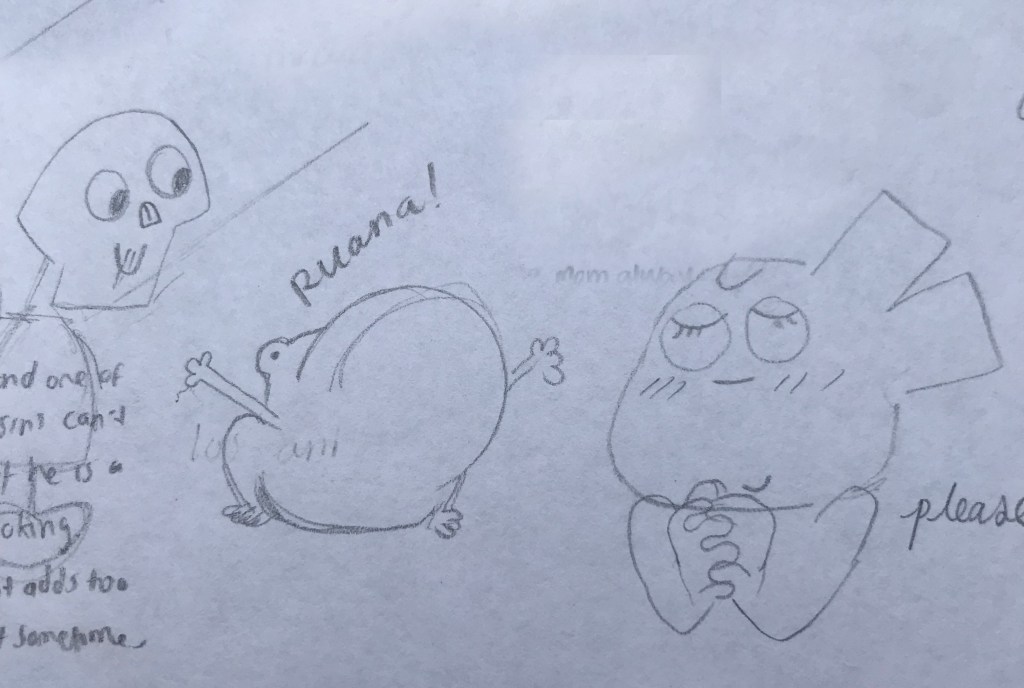
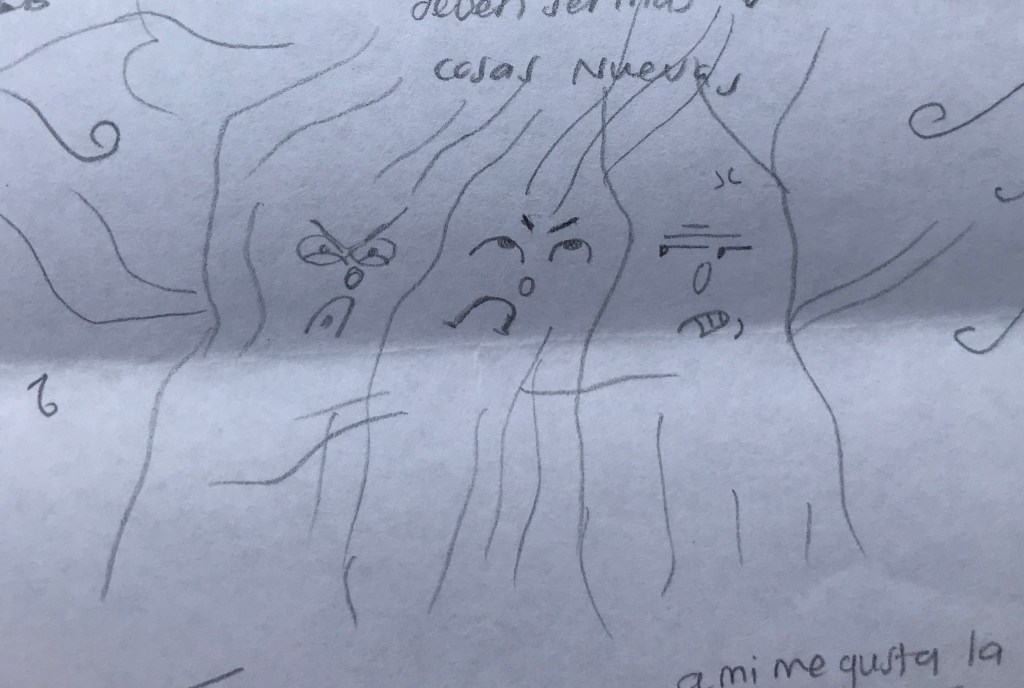


At some points in the writing process, I found myself with mental blocks on how to follow the story. If this happens to you, I discovered something that might help you as much as it helped me. I recommend that you observe what events have occurred in your life recently, they can be from that same day, think about what objects you have used, stories you heard, feelings you felt, etc., and use them in the story. Even if you are going to remove them from the story later, it is a method that works very well to continue writing and get out of the block by creating new possibilities that perhaps you would not have thought of. Even these new possibilities can be much more exclusive since they are things that have only happened to YOU and no one else, they end up being much more unique and personal.

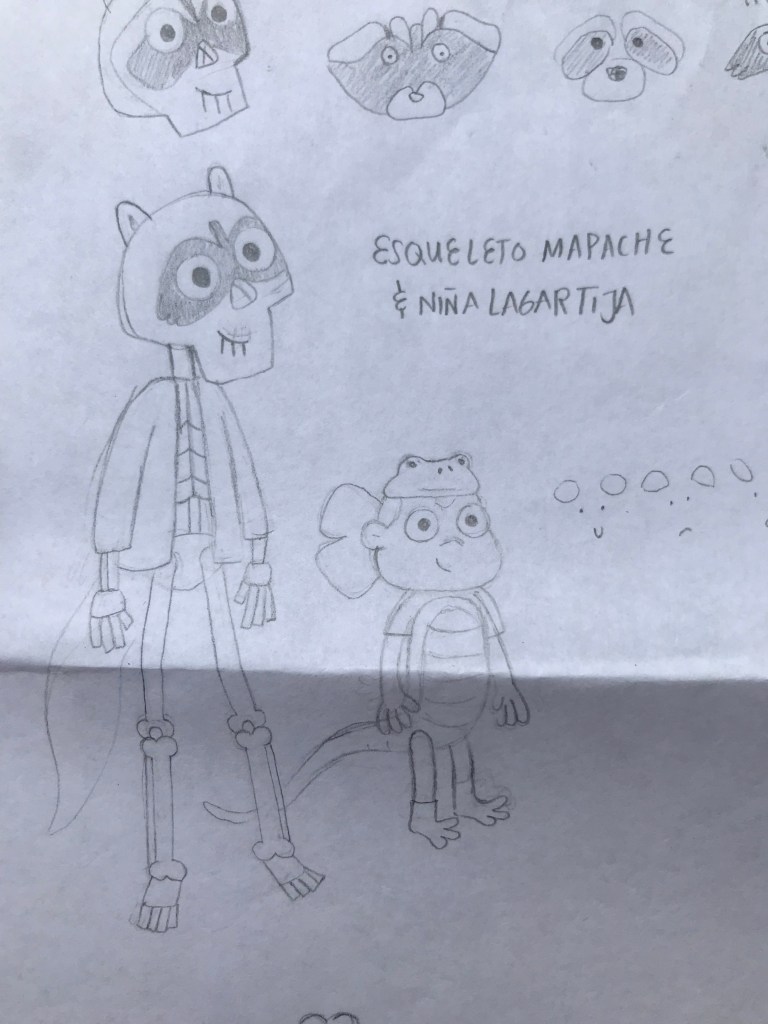
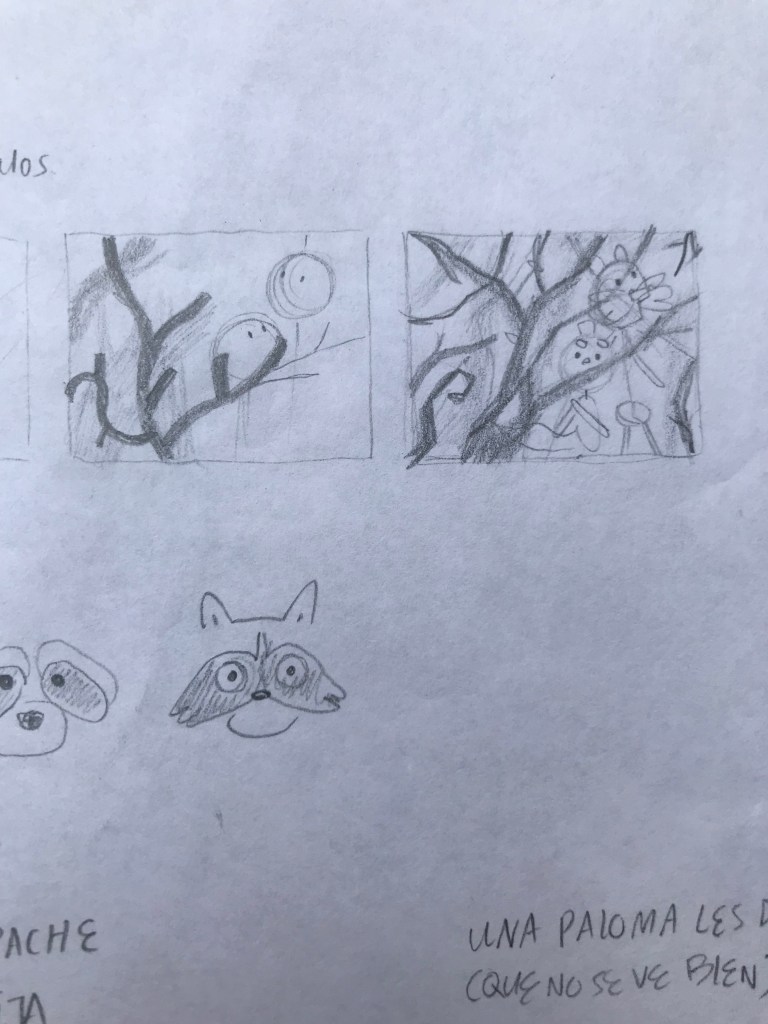
What comes next is to review this first version twice (or as many times as necessary) until I am satisfied to continue with the illustrated part.

My Week on Senses
👂 How you ever wonder how termites sound while eating wood?
👀 I am amazed by Japanese woodblock printing and I recently discovered this documentary about Hasui Kawase where he talks about his entirely process.
👅 Trying this fermented garlic recipe. Fermented food is so good for gut health! And I love that flavour between fresh and rotten.
👐 I am not the one playing the guitar, but please watch Malinda Herman playing a cover of “Put your Head on my Shoulder”. I cried watching this.
👃 The basil I’m planting is growing and is starting to smell. Yay! Fresh Pesto is coming.

Again, thank you so so much for reading and your support.
Coming Up Next
- Disturbing books!
🌟Recommend and subscribe to the newsletter! 🌟 I write weekly about art, creativity, and processes.
 Tina Ovalle
Leave a comment